



SBA Awards $5 Million to Maine Community College System to Expand Manufacturing Training
Auburn, ME – Central Maine Community College hosted the U.S. Small Business Administration (SBA) and SBA Deputy Administrator, Bill Briggs, Wednesday as the Maine Community College System received a $5 million award to expand hands-on manufacturing workforce training across Maine.
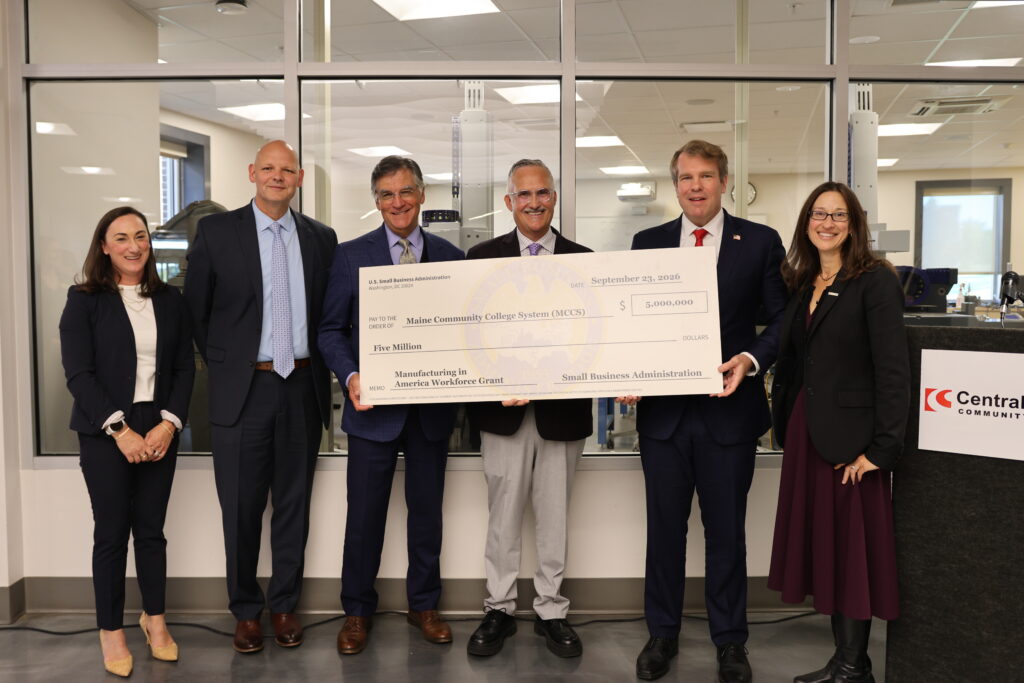
Pictured (L to R): Dr. Kristen Miller (President of Southern Maine Community College), Dr. Michael Fischer (President of York County Community College), David Daigler (Maine Community College System President), Dan Belyea (MCCS Chief Workforce Development Officer), William (Bill) Briggs (SBA Deputy Administrator), and Dr. Susan Rogers (President of Central Maine Community College).
The award, presented during a ceremony at CMCC’s Precision Machining Technology Center, will support SMART-ME, a 12-month initiative funded through the SBA’s Empower to Grow (E2G) Grant Program. The initiative will provide training for workers in Maine’s shipbuilding, aerospace, industrial machinery, metal fabrication, and advanced manufacturing sectors.
CMCC is one of three Maine community colleges participating in SMART-ME, along with Southern Maine Community College and York County Community College. Across the three campuses, the initiative will offer eight training programs and is expected to train 612 individuals.
At CMCC, the initiative will support Manufacturing Technician Training, Advanced Manufacturing Technician Training, and MIG/TIG Welding. Manufacturing Technician Training and Advanced Manufacturing Technician Training will be offered through both CMCC and Southern Maine Community College, while MIG/TIG Welding will be offered at CMCC.
“This investment will allow CMCC to expand the important role we play in preparing Maine’s workforce and supporting the manufacturers that drive our economy,” said Dr. Susan Rogers, President of Central Maine Community College. “Our students benefit when education and industry work closely together, and our employer-partners benefit from having access to the skilled workers they need to grow and innovate. The direct impact of this training will be more men and women in careers that pay a thriving wage, a strengthened manufacturing sector, and stronger communities right here in our region.”
During Wednesday’s visit, Briggs and other SBA officials toured CMCC’s Precision Machining Technology Center and spoke with students and instructors. The event also brought together representatives from Maine’s manufacturing and workforce development community, including industry partners and local manufacturers.
“Our workforce training is most effective when it starts with listening to employers and understanding the challenges they are facing,” said Dr. Dwayne Conway, Dean of Workforce Development at Central Maine Community College. “This investment will give CMCC additional capacity to work directly with manufacturers, develop training around their specific needs, and bring that training to both new and existing employees. Whether a company is adopting new technology, developing its current workforce, or preparing for future growth, we want CMCC to be a resource that can respond quickly and effectively.”
“Advanced manufacturing is changing rapidly, and employers need training that can evolve just as quickly,” said Dr. David Lewis, Dean of Academic Affairs at Central Maine Community College. “CMCC has strong programs, experienced faculty, and hands-on training in areas such as precision machining, metal fabrication, advanced manufacturing technology, automation, and robotics. This funding will allow us to build on those strengths, respond directly to the needs of Maine manufacturers, and provide students and incumbent workers with the skills they need to succeed in an increasingly technology-driven industry.”
SMART-ME is scheduled to run from September 30, 2026, through September 29, 2027, with new training cohorts launching every four to eight weeks across the participating campuses. The initiative is designed to provide industry-recognized credentials and create direct employer pipelines into Maine’s small manufacturers and broader defense supply chain. Participants will also receive a $2,400 attendance incentive.