About Life Sciences
Interested in becoming a doctor, pharmacist, biologist, or pursuing another career in science or healthcare? Life Sciences is a great place to start.
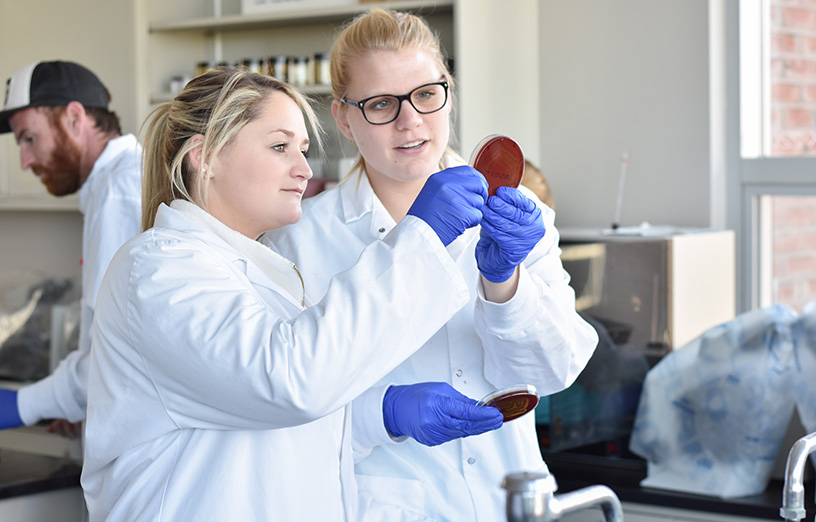
At Central Maine Community College, you will build a strong foundation in biology, chemistry, and scientific research while gaining hands-on lab experience. You will develop skills in data analysis, scientific communication, and the safe use of laboratory equipment, all essential for continued study.
Most careers in this field require advanced education, and this program is designed as the first step toward those goals. Graduates transfer to four-year institutions to continue their studies in areas such as neuroscience, biochemistry, marine science, and medical sciences.
Advanced Lab Courses
Central Maine Community College offers advanced, college-level laboratory science courses that provide strong preparation for continued study in science and healthcare fields. These courses combine lecture and lab components to give students extensive hands-on experience with scientific concepts, methods, and laboratory instrumentation.
Biology & Life Sciences
- BIO 110/111 Fundamentals of Environmental Science (Lecture and Lab)
- BIO 115/116 Anatomy and Physiology I (Lecture and Lab)
- BIO 117/118 Anatomy and Physiology II (Lecture and Lab)
- BIO 131/132 Biology I (Lecture and Lab)
- BIO 133/134 Biology II (Lecture and Lab)
- BIO 181/182 Biotechnology (Lecture and Lab)
- BIO 211/212 Microbiology for Health Sciences (Lecture and Lab)
- BIO 222/223 Genetics (Lecture and Lab)
Chemistry
- CHY 121/122 General Chemistry I (Lecture and Lab)
- CHY 123/124 General Chemistry II (Lecture and Lab)
- CHY 221/222 Organic Chemistry I (Lecture and Lab)
- CHY 251/252 Organic Chemistry II (Lecture and Lab)
Physics
- PHY 151/152 General Physics I (Lecture and Lab)
- PHY 153/154 General Physics II (Lecture and Lab)
- PHY 251/252 Physics I with Calculus (Lecture and Lab)
- PHY 253/254 Physics II with Calculus (Lecture and Lab)
About These Courses
Central Maine Community College is one of the few community colleges in New England offering advanced laboratory science coursework that mirrors four-year institution expectations. These courses combine rigorous lecture and lab components to prepare students for transfer into competitive science, healthcare, and research programs.
Where Graduates Transfer
Graduates of the Life Sciences program transfer to four-year institutions to pursue degrees in biology, healthcare, and other STEM fields, often continuing on to advanced professional or graduate programs.
Frequently Asked Questions
What is the purpose of the Life Sciences program?
The Life Sciences program at Central Maine Community College is designed to provide students with a strong foundation in biology, chemistry, and scientific research. It serves as a starting point for students who plan to continue their education in science or healthcare fields that require advanced degrees.
What will I study in this program?
You will study core topics in biology and chemistry while gaining hands-on experience in laboratory settings. Coursework includes areas such as biology, anatomy and physiology, microbiology, genetics, environmental science, chemistry, organic chemistry, and physics. Students also build skills in data analysis, scientific communication, and the safe use of laboratory equipment through lecture and lab-based courses.
How challenging is the Life Sciences program?
The Life Sciences program is academically rigorous and designed to prepare students for upper-level coursework at four-year colleges and universities. Classes include both lecture and lab components and require consistent effort, critical thinking, and attention to detail.
What careers or pathways does this program lead to?
This program is designed primarily as a transfer pathway into four-year and advanced degree programs. Many careers in science and healthcare require education beyond a bachelor’s degree, and graduates typically continue their studies in fields such as neuroscience, biochemistry, biology, marine science, oceanography, medical sciences, and pre-health pathways such as pre-physician assistant. Students may also gain exposure to entry-level laboratory or healthcare roles while continuing their education.
Related Programs
Your Future at CMCC
Take the Next Step