February 28, 2018
February 28, 2018
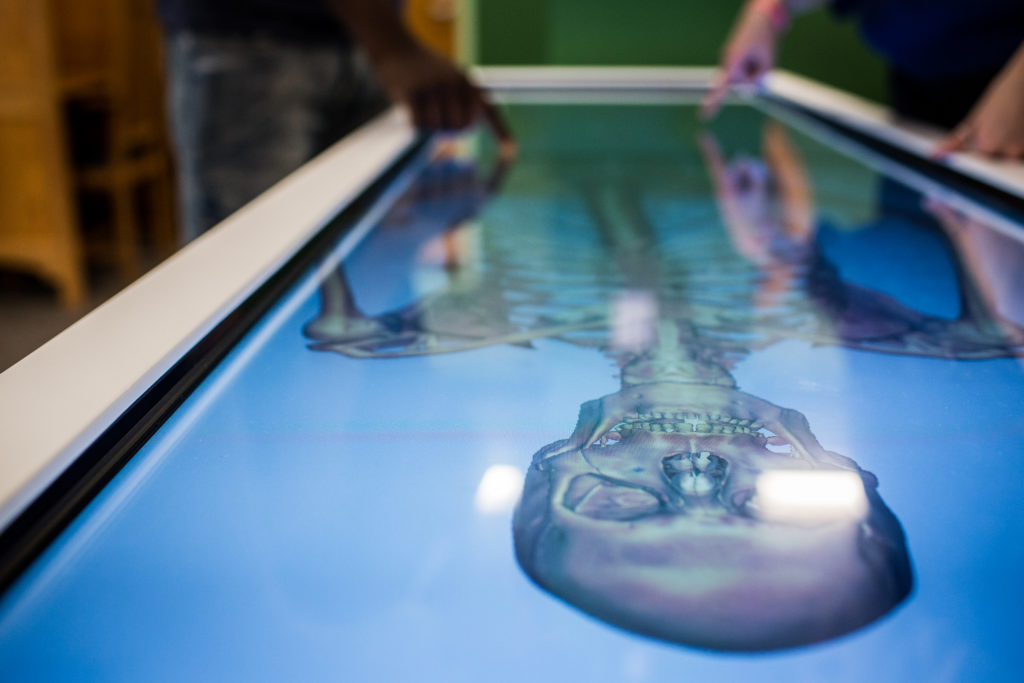
There is a fascinating new addition in the Learning Commons: the Anatomage Table, billed as the world’s first virtual dissection table.
The Anatomage Table is a fully segmented, real human, three-dimensional (3D) anatomy system. Users can visualize human anatomy just as they would with a cadaver. Individual structures are reconstructed in accurate, high-definition 3D, resulting in highly accurate real anatomy, dissectible in 3D. The table allows for maximum flexibility in the exploration of human anatomy.
The table actually works much like a huge iPad, complete with various programs and formats that display all aspects of both male and female anatomy. The Table’s touch-interactive display system is being adopted by some medical, nursing and health sciences institutions. It has been featured on PBS, in medical journals and at conferences.
“This tool really helps the college incorporate innovative teaching and learning strategies to educate future health care professionals,” said Betsy Libby, academic dean at CMCC.
-
-
The Anatomage Table provides exceptional detail into human anatomy.
February 22, 2018
The College recently upgraded its Rapid Prototyping lab with the acquisition of two new 3D printers. These “dual extrusion” machines have a large 12″ x 12″ x 12″ build area that is fully enclosed with an all-aluminum metal frame.
The machines come with a 7″ full-color touchscreen built into the printer and have a heated bed and all-metal, hot end capable of reaching 300 C, allowing for greater material and printing possibilities. The touchscreen can access your print files via WiFi, LAN, USB or SD card. The machines can print with two different colors at the same time, or pair one material with a dissolvable support material.
February 20, 2018
No fewer than five CMCC alums were among the graduates of the 33rd Basic Law Enforcement Training Program (BLETP) at the Maine Criminal Justice Academy. The graduation ceremony was held in December at the academy, which is located in Vassalboro.
This 18 week, residential, paramilitary academy is required training for all full-time law enforcement officers in Maine. Cadets learn the basic tenets of modern law enforcement, including the importance of chain of command, the principles of community policing, effective communications, report writing, problem-solving, ethical standards, and lifetime fitness.
The five CMCC alums who successfully completed the 33rd BLETP are Tyler Barnies and David Morin of the Auburn PD; Chelsea Merry, Somerset County Sheriff’s Department; Beth Nyberg, Brunswick PD; and Greg Mailhot, Sabattus PD. Beth was a General Studies student who also completed some CJ courses. The other four are graduates of the Criminal Justice program. David also completed the Advanced Certificate in Police Operations last year.
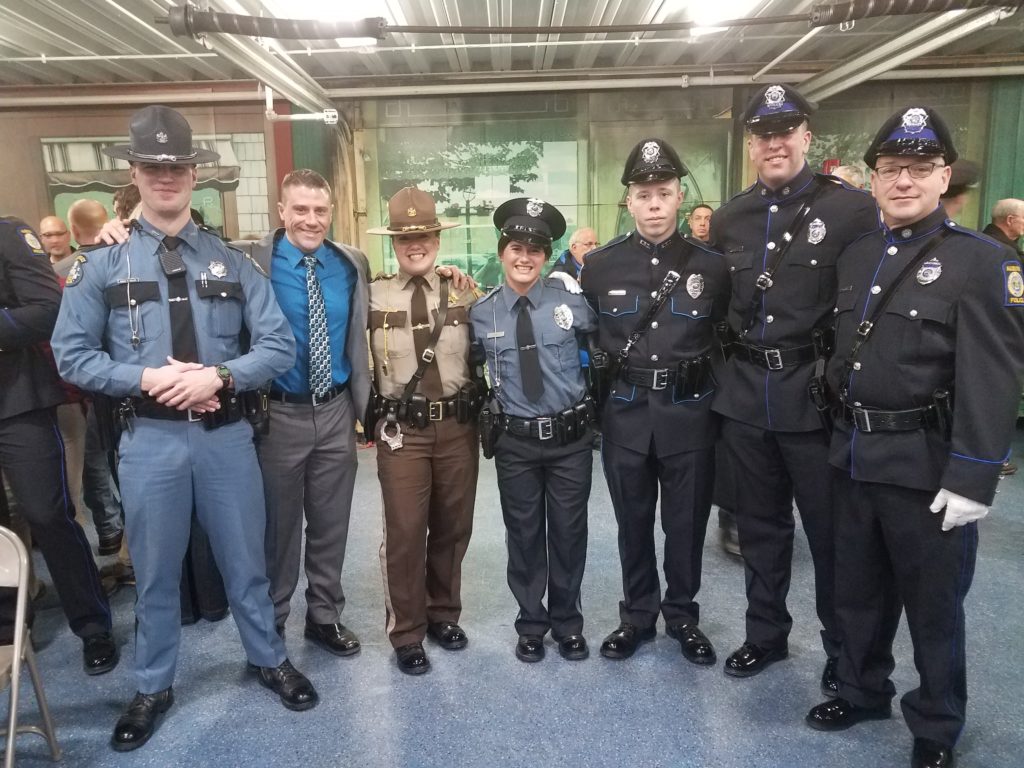
Left to right in the photo are Trooper Connor Willard, a CMCC grad who completed the academy last year; Matt Tifft, chair of the CMCC Criminal Justice program; Chelsea Merry, Beth Nyberg, Greg Mailhot, Tyler Barnies, and David Morin.
January 25, 2018
 Adam Clarke, ACSM CPT (at left) presents a check to Dave Gonyea, director of athletics at Central Maine Community College (CMCC) to help support the athletic programs at the college. Clark also presented a check to support the Culinary Arts program at CMCC. The funds were raised during last fall’s Lake Auburn Marathon, sponsored by Moving ME Forward, a local non-profit whose mission is to “mentor, inspire and grow opportunities for individuals to cultivate change in health and fitness in our communities.” Moving ME Forward is also a major partner of the College in the Physical Fitness Specialist program and the Fitness Center. The manager of the Mustang Fitness Center at CMCC, Clarke was one of the first graduates of the Physical Fitness program and now mentors new students in the program.
December 20, 2017
December 15, 2017
Central Maine Community College is now an approved U.S. Passport Acceptance Facility. Citizens may apply in person for their passport at CMCC’s Central Services Office, located in Room J115 on the ground floor of Jalbert Hall. Passport hours of operation are as follows:
| Monday |
8am-3pm |
| Tuesday |
8am-3pm |
| Wednesday |
8am-6pm (8am-3pm starting 1/16/18) |
| Thursday |
1pm-6pm (11am-6pm starting 1/16/18) |
| Friday |
8am-3pm |
CMCC’s full-service Passport Acceptance Facility includes application and photo services. Appointments are not required. Passport forms, passport fees, information on how to apply and more can be found on the State Department website for passport and travel information at travel.state.gov. For more information, please contact Kellie Morris, passport program manager at CMCC, at
(207) 755-5294.
December 13, 2017
The Corporate and Community Services Department at Central Maine Community College will offer QuickBooks: Intermediate and Basic Tasks on Thursday mornings, January 12 through February 9, from 9:30 a.m. to noon.
QuickBooks is the one of the most popular small-business computer accounting packages available. This course will be taught using QuickBooks Premier 2015; however, many of the skills learned will be transferable to other version of QuickBooks. Class participants will learn how to set-up an accounting system, manage accounts payable and receivable functions, create invoices, print checks, and create financial statements. While there are no prerequisites, a basic understanding of Microsoft Windows is recommended.
Registration for this course is open and ongoing, however space is limited. The cost is $99.00 and includes all materials. For more information, please contact Corporate & Community Services at 207-755-5280, training@cmcc.edu or visit www.cmcc.edu/ccs to register online. Deadline for registration is January 5.

December 1, 2017
 It is called Kairos, an ancient Greek word meaning the opportune and decisive moment. Tucked between Jalbert Hall and The Tower and clearly visible from the Hall of Flags, this sculpture by artist James Strickland reflects in several ways, the mission and work of CMCC. When asked to describe this work, Mr. Strickland shared the following:
There are three elements to the sculpture. The first element is the shapes forming the abstracted letters CMCC. They are constructed from TIG welded 6061 T6 aluminum sheets and given a swirl sanded finish. This provides a sturdy base for the second element, a grid reminiscent of the commonly seen 6 over 6 window pane configurations found throughout New England. The grid is placed upon the plinth via a series of gimbaled bearings that allow the cage element to rotate freely 360 degrees in the slightest breeze. The third element of the work is abstracted laurel leaf shapes. These shapes represent the academic achievements of the faculty and the high level of academic opportunity available at CMCC. The abstracted laurel shapes are gold leafed and also reference flames of early navigation bonfires, with allusion to the Lighthouse of Alexandria, one of the Seven Wonders of the World, which announced the important library and scholarly prestige of that ancient city.
This sculpture was commissioned through the Maine Percent for Art Program. Recognizing the need to enhance culture and the arts and to encourage the development of artists, the Legislature to established the Percent for Art Program to provide funds for and authorize the acquisition of works of art for certain public buildings and other public facilities.
November 7, 2017
 More than 40 students were welcomed last month as new members of the Alpha Phi Xi Chapter of Phi Theta Kappa (PTK), the international honor society for two-year colleges. To be eligible for Phi Theta Kappa membership, students must be pursuing an associate degree and have a cumulative grade point average of at least 3.5 on a 4.0 scale. An induction ceremony was held on November 7. Among the new members are Alexander Agostino, Danielle Atter, Lisa Bailey, Ashley Bisson, Angela Cafarelli, Deborah Chase, Danya Cummings, Mary Dempsey, Bryanna Handlon, Jennifer Hatch, Micayla Hill, Dorothy Holmes-Picard, Stephanie Hopkins, Leonardo Jimenez-Ubillus, Jennifer King, Colby Knapp, Jason Kramer, Olivia Labrecque, Parker Lafrance, Dylan Larose, Amber Lewis, Michael Libby, Shelby Lizotte, Richard Maguire, Quinn Mitchell, Adam Nickerson, Ouseiny Ousmane, Kelly Pinette, Cecile Plourde, Hannah Pulleh, Alyssa Richardson,Cameron Rothwell, Kassie Schmidt, Alice Sherwood, Melinda Straight, Amy Therrien, Brandon Tiger, Matthew Tremble, Dakota Ward, Nichola Wilson, McKenzie Wing, and Ahmed Yussuf.
Installed as chapter officers for 2017-18 were Melissa Potter, president; Walter DuBeau, vice president; Adam Soto, public relations secretary; and Jessica Lemay, treasurer
October 31, 2017
 Government, industry, and education officials joined Central Maine Community College (CMCC) students and employees at a dedication ceremony on October 27 for the official opening of the Gene Haas Precision Machining Technology (PMT) Center at the College.
The College began work on the project in spring 2017. The first phase involved an interior renovation of over 5,000 square feet, including the relocation of the quality control room, offices, computer class, and locker room to update and improve overall functionality. Phase Two was the construction of a 3,600 square foot addition to accommodate recent equipment acquisitions, and improvements to existing electrical power distribution, lighting systems, and the mechanical ventilation system.
The Gene Haas Foundation awarded the College a grant of one million dollars toward this expansion project. Founded in 1999 by Haas Automation founder and Stewart-Haas Racing co-owner Gene Haas, the Haas Foundation has granted more than $12 million to institutions that champion advanced manufacturing education. The Haas Foundation has been a generous supporter of the PMT program and machinist-based continuing education at CMCC for many years.
In addition to the Haas funds, the College secured a grant of $1.6 million from the U.S. Department of Commerce’s Economic Development Administration (EDA). Officials from the EDA have noted that not only do many companies use the machining center at CMCC for employee training and access to specialized equipment, but that this expansion is a timely one given that area employers expect to need an additional 900 precision machinists in the next five years.
The College also received a grant of $250,000 from the Northern Border Regional Commission (NBRC) as part of $2 million in funding it has provided to upgrade infrastructure and provide job-training skills across the state. The NRBC is a federal-state partnership Congress created in 2008 to help alleviate economic distress and encourage private-sector job creation throughout the northern counties of Maine, New Hampshire, Vermont and New York.
“The expansion of the PMT facility will enable the program to build on the significant accomplishments funded previously under two grants totaling 2.3 million dollars from the National Science Foundation (NSF), noted Scott Knapp, president of CMCC. Those efforts resulted in the creation of a “virtual collaboration infrastructure,” an environment in which both design and precision machining students work in concurrent or virtual product design and development; and the development of curriculum for 3D machining and CNC machining that address industry needs in high-end skills that are directly applicable to the precision manufacturing environment.
Richard Bolding, chair of the PMT program at the College, noted that skilled graduates are in high demand and that many of them have jobs by the end of their first year on campus. “The expansion of the PMT program will help support the growth of good-paying, high technology jobs in the region and throughout the state,” Bolding added.
The PMT program at CMCC, the largest in the Northeast, offers a two-year associate in applied science degree, a one-year certificate, and an advanced certificate. Students are trained in conventional and CNC (computer numeric control) machining. Graduates of the program are employed as machine operators, CNC machinists, tool and die makers, quality control inspectors, machine assemblers, machine tool designers, CNC programmers or field service representatives.
For more information about Precision Machining Technology at CMCC, please contact Richard Bolding at 207-755-5307 or rbolding@cmcc.edu. Visit the College website at www.cmcc.edu.
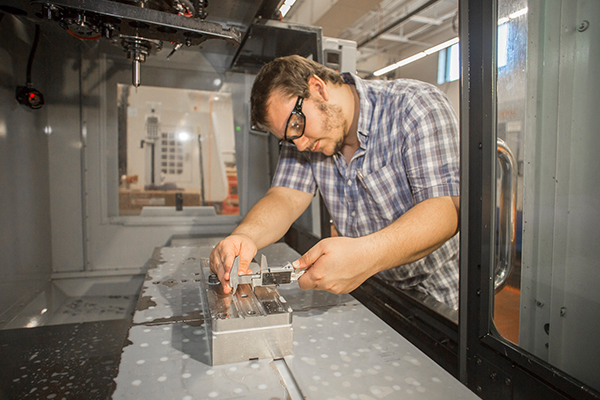
Photo caption 1: Precision Machining student Nicholas Kondax cuts the ribbon at the dedication of the Gene Haas Precision Machining Technology Center at CMCC. Looking on from left are Kathy Looman, administrator for the Gene Haas Foundation; Amy Landry, executive director of the Androscoggin Valley Council of Governments; Kondax; Alan Brigham, economic development representative from the EDA; Mark Scarano, federal co-chair at the Northern Border Regional Commission; and Diane Dostie, recently retired as dean of corporate and community services at CMCC.
Photo caption 2: Working at a Haas VM 2 vertical mold machine, student Cameron LaMadeleine measures the tolerance of a part to determine if it is in tolerance. The expansion of the precision machining lab at CMCC has provided much-needed space for this and other recently acquired machining equipment.
